Moving Beyond Manual Nodes: The Rise of Automated 3D Generative Workflows
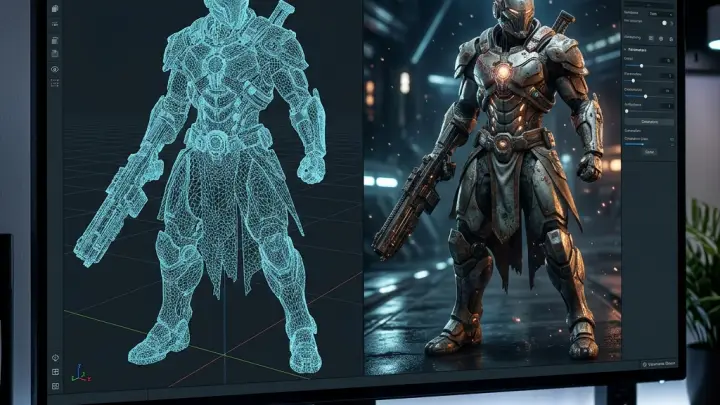
The world of three-dimensional digital art has historically been guarded by a steep technical barrier to entry. For decades, independent game developers, graphic designers, and digital hobbyists have had to spend hundreds of hours mastering complex software suites just to produce basic geometric shapes. Mastering vertex manipulation, node-based shading, and manual UV unwrapping required a heavy investment of time that often deterred pure creative exploration. Today, that technical barrier is collapsing rapidly due to the emergence of automated generative platforms. Leading this paradigm shift is Neural4D, an advanced AI reconstruction system jointly developed by Nanjing University, DreamTech, Oxford University, and Fudan University. This academic and commercial alliance has produced a platform that replaces manual vertex pushing with highly automated, intelligent processing.
For creators looking to bypass the complexities of traditional modeling environments, the search for the Best AI alternatives to Blender often leads to these new generative pipelines. Instead of spending weeks learning how to cleanly extrude a mesh or balance polygon counts, users can now input a single 2D image and rely on Neural4D to handle the heavy mathematical lifting. This automated approach allows creators to focus on composition, narrative, and artistic direction rather than getting bogged down in the minutiae of technical troubleshooting.
The Bottleneck of Traditional 3D Modeling
To understand why automated reconstruction is gaining so much traction, one must examine the specific pain points of legacy 3D workflows. Software built around manual manipulation relies on a linear, highly technical process.
When an artist sits down to build a character or a complex prop, they face a series of rigid steps:
· Base Mesh Construction: Extruding individual faces and manipulating vertices to form a rough silhouette.
· Retopology: Manually redrawing the mesh to ensure clean edge flow, which is necessary for animation and rendering optimization.
· UV Unwrapping: Flattening the 3D model into a 2D space so textures can be applied without distortion.
· Texture Baking: Projecting high-resolution details onto lower-resolution meshes.
Each of these steps requires specific technical knowledge. A single error in retopology can cause lighting artifacts or animation glitches that ruin hours of work. For solo developers building expansive video games or interactive experiences, the sheer volume of assets required makes this manual pipeline fundamentally unsustainable.
Architectural Solutions in Generative 3D
The core appeal of modern automated systems is their ability to bypass these manual bottlenecks through applied machine learning. The architecture driving these new workflows evaluates a 2D reference image and mathematically infers the missing spatial data.
Automating Topology and Edge Flow
One of the most technically demanding aspects of manual modeling is maintaining a quad-dominant mesh. Triangles and complex polygons often render poorly or deform badly during animation. The Direct3D-S2 architecture powering advanced generators specifically addresses this issue. As the neural network builds the volumetric representation of the object, a secondary processing layer enforces a clean topological structure.
This means the final output is not a chaotic scatter of geometric points, but a structured, optimized mesh that is immediately usable in game engines like Unity or Unreal Engine. The system analyzes the physical curvature of the object and automatically aligns the edge flow to match, simulating the careful planning of a human modeler.
The Eradication of Manual UV Unwrapping
Perhaps the most universally disliked task in traditional modeling is UV unwrapping. Slicing a complex 3D shape and laying it flat without stretching the texture coordinates is a tedious geometric puzzle.
Automated AI workflows eliminate this step entirely. When the system extracts intrinsic PBR materials (such as Albedo, Roughness, and Normal maps) from the reference image, it simultaneously projects these textures onto an auto-generated UV map. The algorithm mathematically calculates the optimal seams and texture density, ensuring uniform resolution across the entire model. The user receives a fully textured, ready-to-render asset without ever interacting with a UV layout screen.
Workflow Efficiency and Specifications
Comparing the operational efficiency of manual node-based software with an automated AI pipeline reveals a stark contrast in productivity.
| Metric / Specification | Traditional Manual Workflow | Automated Neural4D Pipeline |
| Average Asset Creation Time | 10 to 40 hours | 2 to 5 minutes |
| Prerequisite Skill Level | High (requires extensive training) | Low (intuitive image input) |
| UV Mapping Process | Manual seam placement | Fully automated projection |
| Topology Generation | Manual vertex extrusion | Algorithmic quad-dominant output |
| Iteration Speed | Extremely slow | Highly rapid and scalable |
This clear disparity in creation time changes the economics of digital art. A solo creator can now prototype an entire digital environment in a single afternoon, testing different visual aesthetics and iterating on concepts with zero penalty to their production schedule.
Leveraging Community Assets for Scene Assembly
Even with the speed of AI generation, building a complete digital environment often requires a mix of custom hero assets and generic background props. The modern digital creator rarely works in total isolation. An effective workflow involves synthesizing generated models with existing collaborative resources.
When a designer needs to populate a complex virtual street scene, they might use AI to generate the specific, highly detailed main characters or unique vehicles. For the surrounding environment, such as streetlamps, generic benches, or background buildings, they will typically explore 3D asset libraries to find readily available geometry.
By combining automated AI generation for custom focal points with community-sourced background assets, creators can assemble massive, detailed worlds rapidly. This hybrid methodology ensures that computational resources are focused entirely on the unique aspects of the project, maximizing both efficiency and visual fidelity.
The Shifting Landscape of Digital Creation
The transition from purely manual modeling to automated generative workflows marks a definitive turning point for digital art and game development. The steep technical hurdles that once prevented storytellers and independent developers from bringing their visions to life are being dismantled. With platforms capable of handling the highly technical burdens of topology, UV unwrapping, and material projection, the focus of 3D creation returns firmly to artistic intent. As these underlying neural architectures grow more sophisticated in their spatial reasoning and optimization, the reliance on tedious manual software will continue to decrease, opening the field of 3D design to a massive new wave of creative talent.