Apple’s Smart Home Bet: Why the Category Stalled — and Whether This Finally Fixes It
Apple is reportedly about to make its boldest move into the smart home yet. According to reporting from Bloomberg‘s Mark Gurman and a raft of other outlets, the company is planning a “Welcome Home” event on October 13 to unveil a dedicated smart home hub — the “HomePad” of the rumors — alongside an updated HomePod mini, a new Apple TV, and a whole new wave of home accessories built with LG and Schneider Electric. If the schedule holds, it would be Apple’s first full-scale assault on a category that Amazon and Google have quietly dominated for a decade.
But here’s the more interesting question, and the one Apple fans and skeptics both should be asking: why is the smart home so hard to get off the ground in the first place? And does Apple actually have what it takes to change that, or is it just bringing a very expensive answer to a problem that most homeowners don’t feel they have?
The smart home has been “coming” for a decade
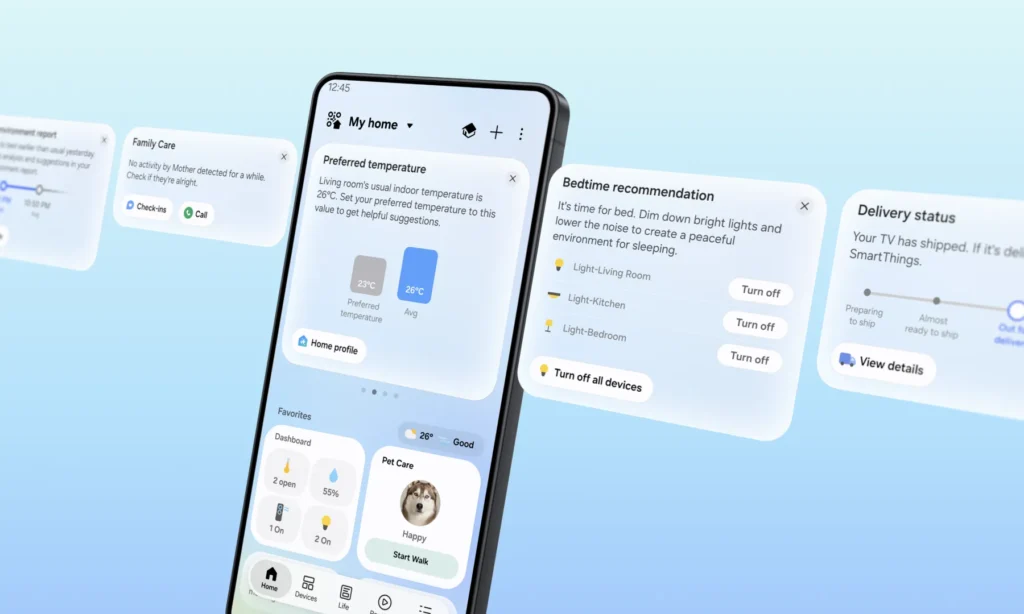
Smart home is one of those categories where the technology kept arriving faster than the enthusiasm. We’ve had smart plugs, smart bulbs, smart locks, smart speakers and smart thermostats for years. Yet walk into the average house and you’ll usually find a handful of disconnected gadgets, each with its own app, each needing its own Wi-Fi network, each half-forgetting you by Tuesday.
That’s the core problem, and it breaks down into a few stubborn causes.
Why the smart home never quite took off
1. Fragmentation made it feel like a chore. Before Matter arrived, the smart home was a Frankenstein of rival ecosystems. Your lock spoke one language, your lights another, your thermostat a third. Setting up a “connected home” often meant juggling five apps, five accounts and five ways of breaking. For a technology whose entire promise is convenience, that was fatal.
2. Trust is the thing no one can automate. A camera watching your living room and a speaker that’s always listening are, by definition, an invasion of the most private space in a person’s life. That’s why cameras from Ring and Nest came with subscriptions, cloud storage and a low-grade sense of unease. People wanted the convenience but were wary of the cost — literally and figuratively. Smart home hit the wall that it asked people to trade their peace of mind for a few smart bulbs.
3. The “why would I” problem. Most of the benefits of a smart home are either tiny (a light that turns on automatically) or expensive (a full automation system). There wasn’t a single, obvious, must-have reason for an ordinary homeowner to commit. You could feel better without it. That’s the difference between a smartphone and a smart plug: one redefined how you live, the other just made your lighting slightly lazier.
4. There was no obvious home for it all. The smart home needed a hub — one place that understood everything in the house and let you control it in plain language. Amazon and Google built those hubs (the Echo Show, the Nest Hub), but the assistants behind them were only good enough to answer questions, not to actually run your home. Voice control stayed brittle, which made the whole thing feel like a party trick rather than a utility.
So what does Apple actually bring to the table?
This is where the rumors get interesting, because almost every reported element of Apple’s push maps directly onto one of the four problems above.
Trust is the brand, not a feature. Apple’s whole identity is privacy. The reporting suggests its own cameras will be built on that principle — one leak describes a tiny camera that doesn’t record video, using AI to sense presence and describe the room instead of storing footage. For a category that lost steam on privacy anxiety, that’s not a minor detail. It’s the actual differentiator. If Apple can sell “a smart home that doesn’t spy on you,” it’s selling the one thing its competitors structurally can’t.
The hub finally gets a real brain. The home hub is reportedly built around Apple’s revamped, AI-powered Siri — the same large-language-model-driven assistant that’s been delayed and reworked for years. A hub that can understand context, handle follow-up questions and actually coordinate devices is what the Echo Show and Nest Hub never quite delivered. If Siri AI is as good as Apple says, the hub stops being a gadget and starts being a butler.
Tap-to-pair kills the worst of the setup pain. One of the reported “second-party” tricks is a HomeKit-exclusive NFC pairing: you tap your iPhone to an accessory, it grabs your network credentials, and it’s on the network. That’s the AirPods magic applied to a smart lock. Pairing was one of the biggest friction points, and Apple reportedly went out of its way to remove it.
The second-party program is the breadth fix. HomeKit’s biggest historical weakness was that its list of certified accessories stayed small, while Alexa and Google had thousands of devices. Apple is reportedly partnering with LG (doorbell, deadbolt, thermostat, cameras) and Schneider Electric (thermostats, sensors) to get real hardware onto the market without having to design every device itself. It’s a “Made for iPhone” model for the home — Apple sets the spec, other makers build to it.
But let’s be honest about Apple’s weaknesses
Naming the problems is easy; solving them is where Apple has historically stumbled, and the same reporting lays out the real risks.
Price. The hub is reportedly being priced around US$350, well above an Echo Show or Nest Hub. At that price, Apple is asking people to commit to the ecosystem before they’ve seen it work — a big ask when the core promise of the smart home is supposed to be low-effort convenience.
Breadth. Even with LG and Schneider in the mix, Apple’s accessory ecosystem will still be far smaller than Amazon’s or Google’s. A smart home is only as good as the things it can control, and a thin lineup keeps the hub feeling like a showcase rather than a system.
Timing. Apple is arriving years after its rivals embedded their assistants — Alexa+ and Gemini for Home — into the speakers, displays and cameras that millions of people already own. Samsung has an even harder-to-beat advantage: its TVs and appliances are already sitting in millions of homes. Apple’s counter is the installed base it already owns (iPhones, Apple TVs, HomePods), but converting ownership into smart home adoption is not automatic.
Matter itself has let people down. The open standard that was supposed to fix fragmentation has been a slow and uneven rollout, and accessory makers keep retreating into their own walled gardens. Apple can’t fix that unilaterally; it can only make its corner of the ecosystem better.
The verdict: Apple has the best ingredients, but the recipe is the risk
For the first time, Apple is fielding a complete argument for the smart home: a private-by-default brand, a genuinely intelligent assistant, painless pairing, and a partner program to build out the hardware. That’s more coherent a story than anything Amazon or Google has told, and it directly attacks the four reasons the category stalled — fragmentation, trust, weak utility and the missing hub.
Whether it actually changes anything comes down to two numbers: price and breadth. If the hub lands at $350 with a thin lineup, it becomes a premium accessory for people who are already in the Apple camp — nice, but not a category-defining moment. If Apple can make the privacy angle land, the setup effortless and the accessory list deep enough to feel like a real system, then it might finally be the product that turns “smart home” from a tech demo into a default.
Given that Apple has a habit of taking late to a category and then making it the only one that matters (the phone, the wireless earbuds), there’s a solid case for optimism. But the smart home is different from those: it’s not a single device, it’s a system, and systems are much harder to win. Watch the October 13 event closely. The real test won’t be what Apple shows — it’ll be whether an ordinary, non-Apple-householder looks at the hub and thinks, “okay, I actually want one of those.”
Note: This is an analysis piece based on current reporting and leaks (Bloomberg/MacRumors/CNET/AppleInsider/Cult of Mac) ahead of Apple’s expected October 13 “Welcome Home” event. Product details, pricing and availability are unconfirmed until Apple announces them.
Further reading:
- MacRumors — Top Stories: Apple Smart Home Launch on October 13
- AppleInsider — Apple is still working on its own smart home cameras
- CNET — Everything We Expect From Apple’s Surprise Smart Home Event
- Cult of Mac — Apple’s smart home plan sounds bigger and bolder than you might think